20260418 Two if by Sea
Two if by sea#
In the first of two painting contests/competitions/events I entered this month, I took a very important first step: I misread the event date and immediately started working on something else.
I suppose that’s not entirely fair. Over the course of a couple days, I had a good think, built a couple models that I couldn’t decide if I was going to use or not, and decided “I can mull this over and figure out what I want to paint for this event later, it’s late next month.” Instead, turns out it was mid-this-month, which means I already burned a couple days messing around with the painting for the second event, which I knew for certain was at the end of April.
First Entry: Necromunda Ambot#
Once I realized my mistake, I got my shit together and started going ham on the first event model, a Necromunda Ambot.
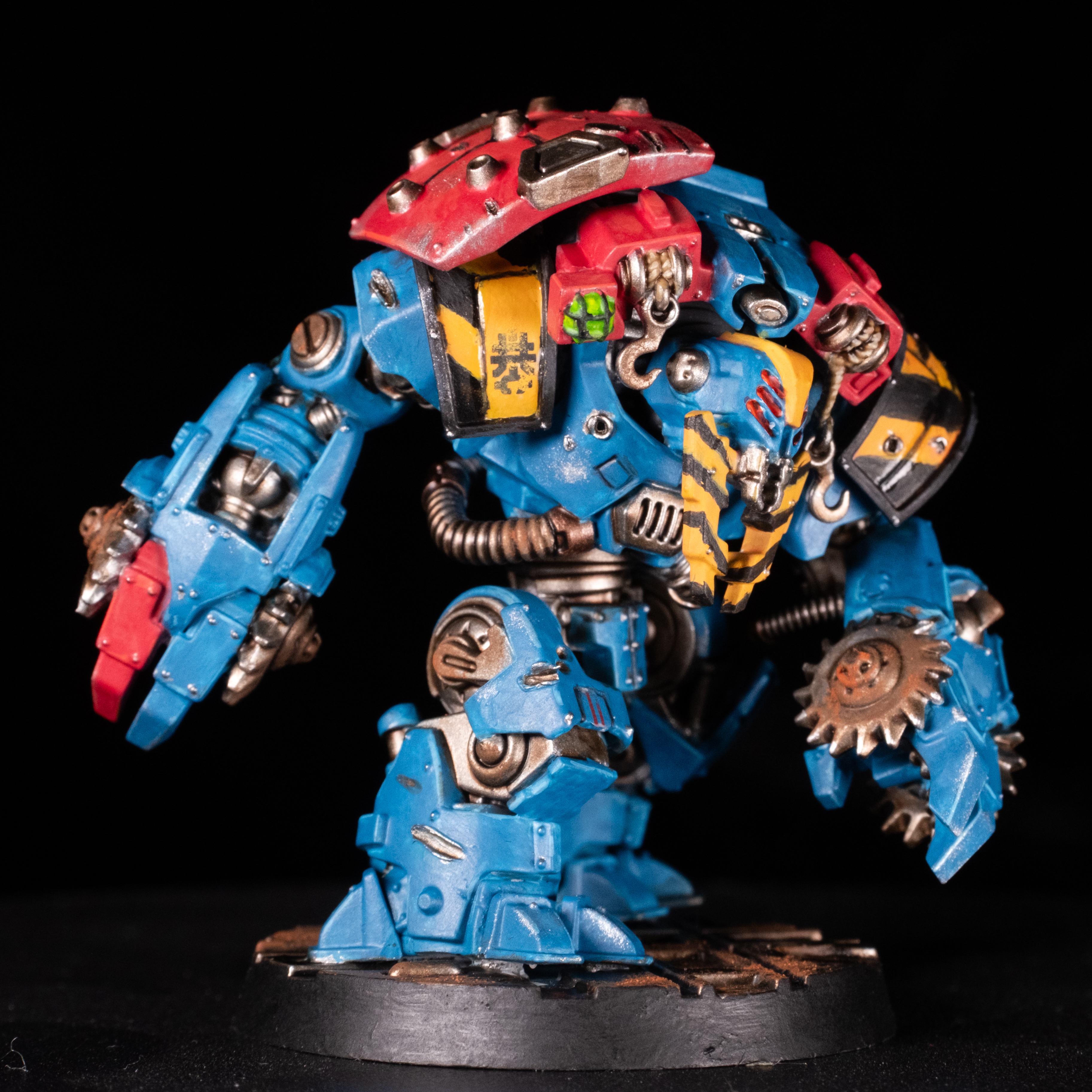
Admittedly the Ambot was initially just one of those “I could paint this for the event” models but after realizing I was already a few days behind, I just committed to the bit and went with it.
This event allowed for two entries per person - my idea was to scratch paint one model for the event and grab something else off the shelf for my second entry. So the Ambot was going to be my bespoke entry, painted from nothing, and my goal was to push myself in the realms of weathering and battle damage. I’ve dabbled in both before, but not extensively (mostly for either Battletech or Gaslands).
But! Battle damage meant I got to utilize one of my favorite tools: Trogdor
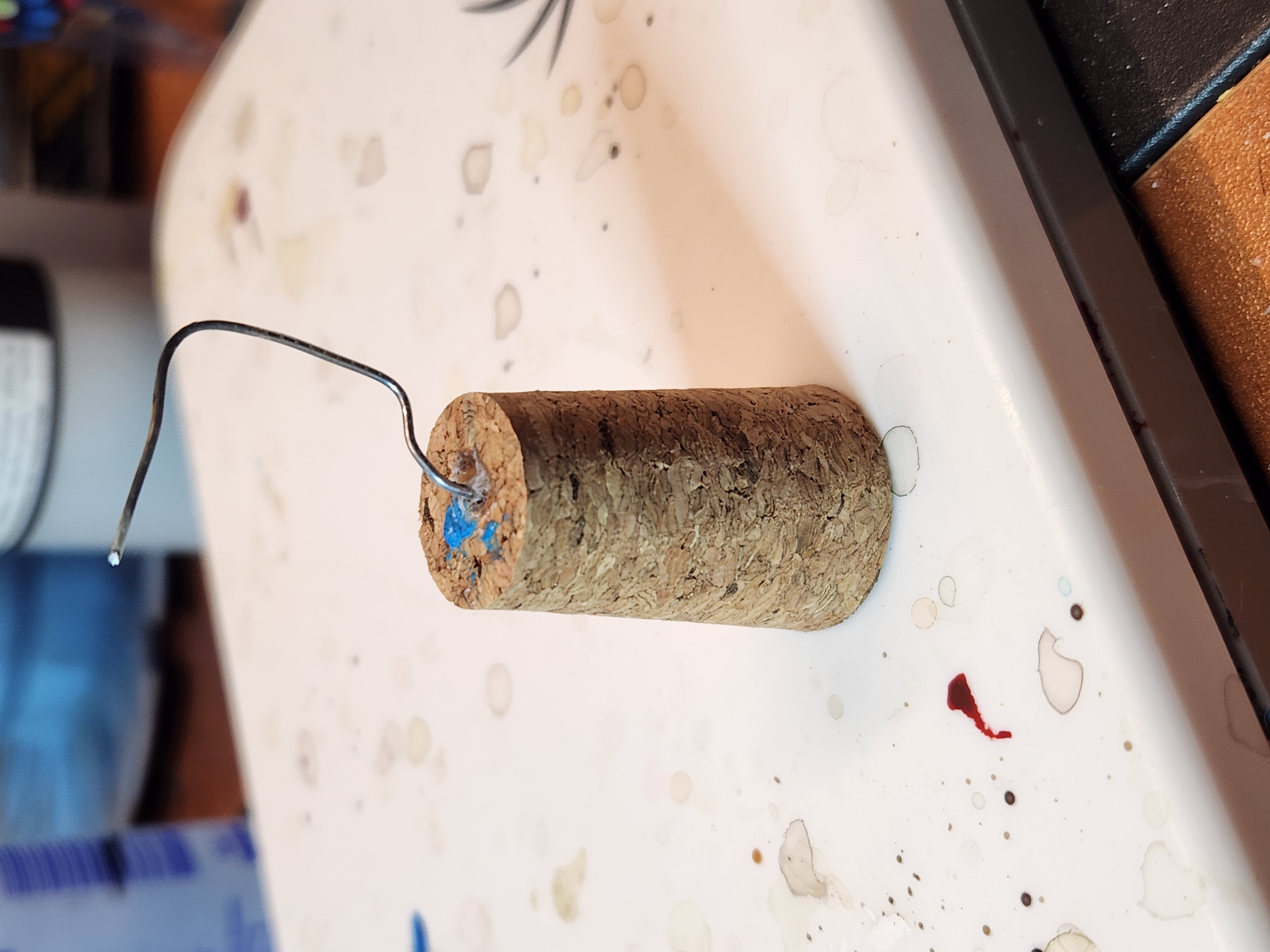
A simple paperclip glued into a cork, its use is also deceptively simple: heat it up with a lighter until it’s red hot, then use it to make bullet holes and gashes on plastic minis. Battle damage is one of those things where you have to be sure not to go overboard, and I made a couple specifically placed holes and gashes on the Ambot, such as on the hazard stripes. (This Ambot that I painted was actually the second Ambot I built as a possible model for this event. The first one went harder in the paint (so to say) with battle damage and was probably a little overboard.) It’s also hard to see in the first image above (more noticable in the video below), but I scraped one of the “nubs” off the shoulder shield for additional damage.
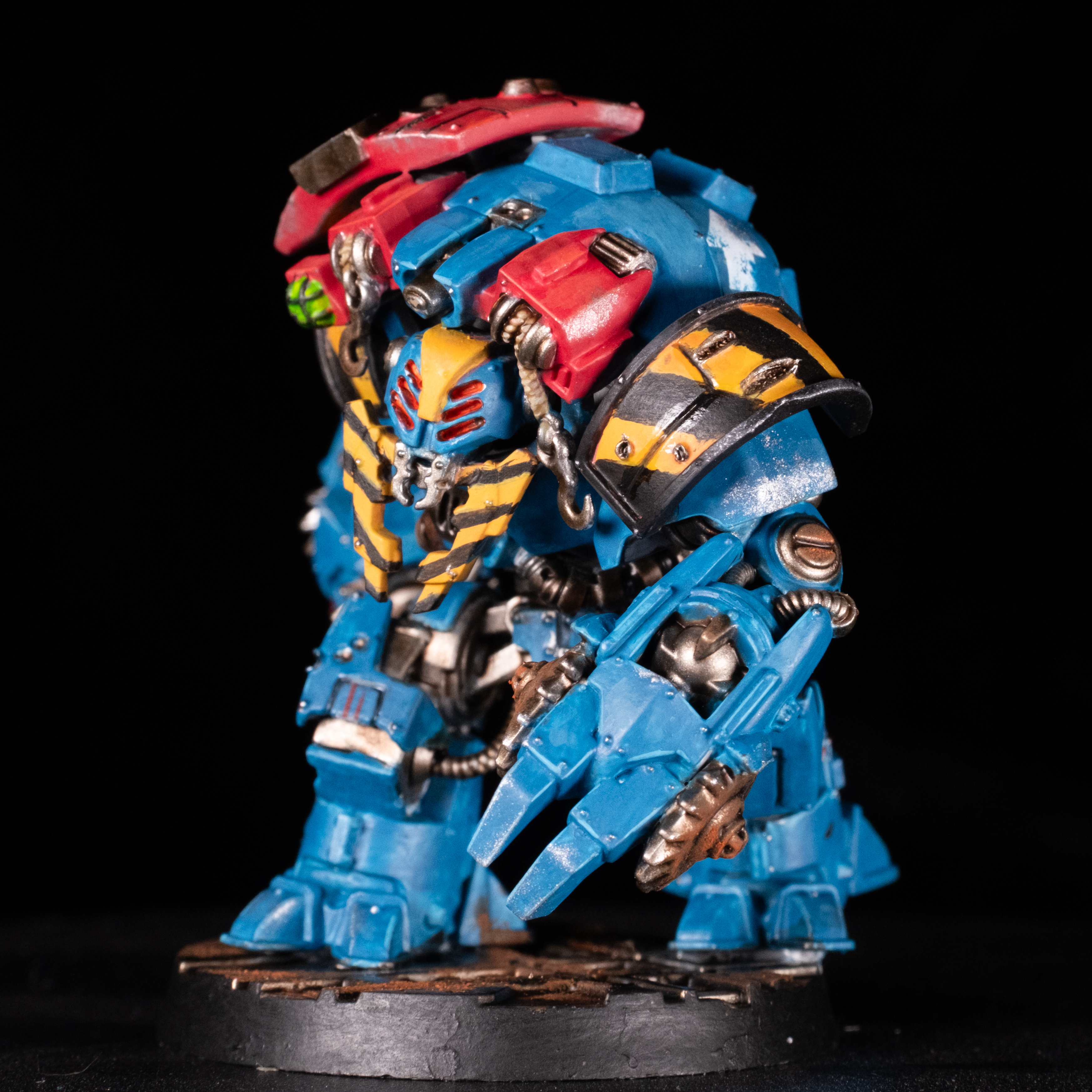
While it wasn’t the immediate intent, I did also paint the hazard stripes freehand, instead of using Tamiya masking tape like I normally do. This was in part due to the battle damange and in part due to the curved surface - I didn’t take enough math classes to figure out how work the curve. It’s another aspect of “pushing myself out of my comfort zone” with this model. Surprising no one, I had a harder time with the hazards on the “mandibles” for a couple reasons - the hazards went across multiple “pieces” as the mandibles are made of 3 or so “parts” on each side, and the small region of coverage meant every brush stroke counted more.
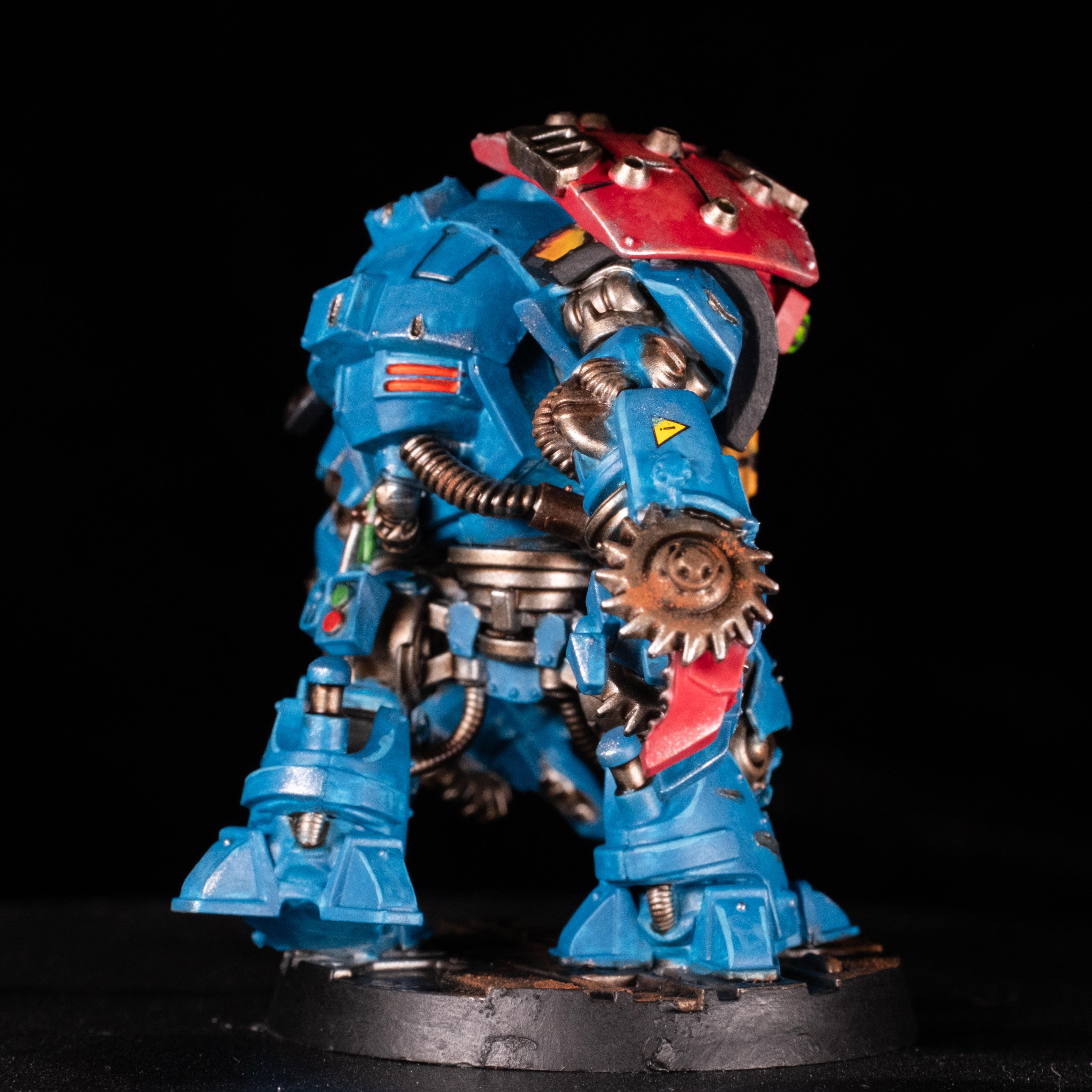
It also has some shading, though I didn’t push that element as far as I could have (and would on a subsequent model, below). Between the large, flat areas on the model and not wanting to wash out the weathering effects, I opted to not utilize my default process of “throw a wash at it” and instead go for (some) lowlights and edge highlighting. This really made me realize how much I rely on washes to hide certain imperfections.
I ended up finding that some of the lowlighting wasn’t intense enough to see well at “tabletop distance”. Up to my face I could see where the “shadows” were based on the lowlight colors, but they were very subtle. “Tabletop highlights” are a different skill than “artistic highlights” and turns out I’m not skilled in either.
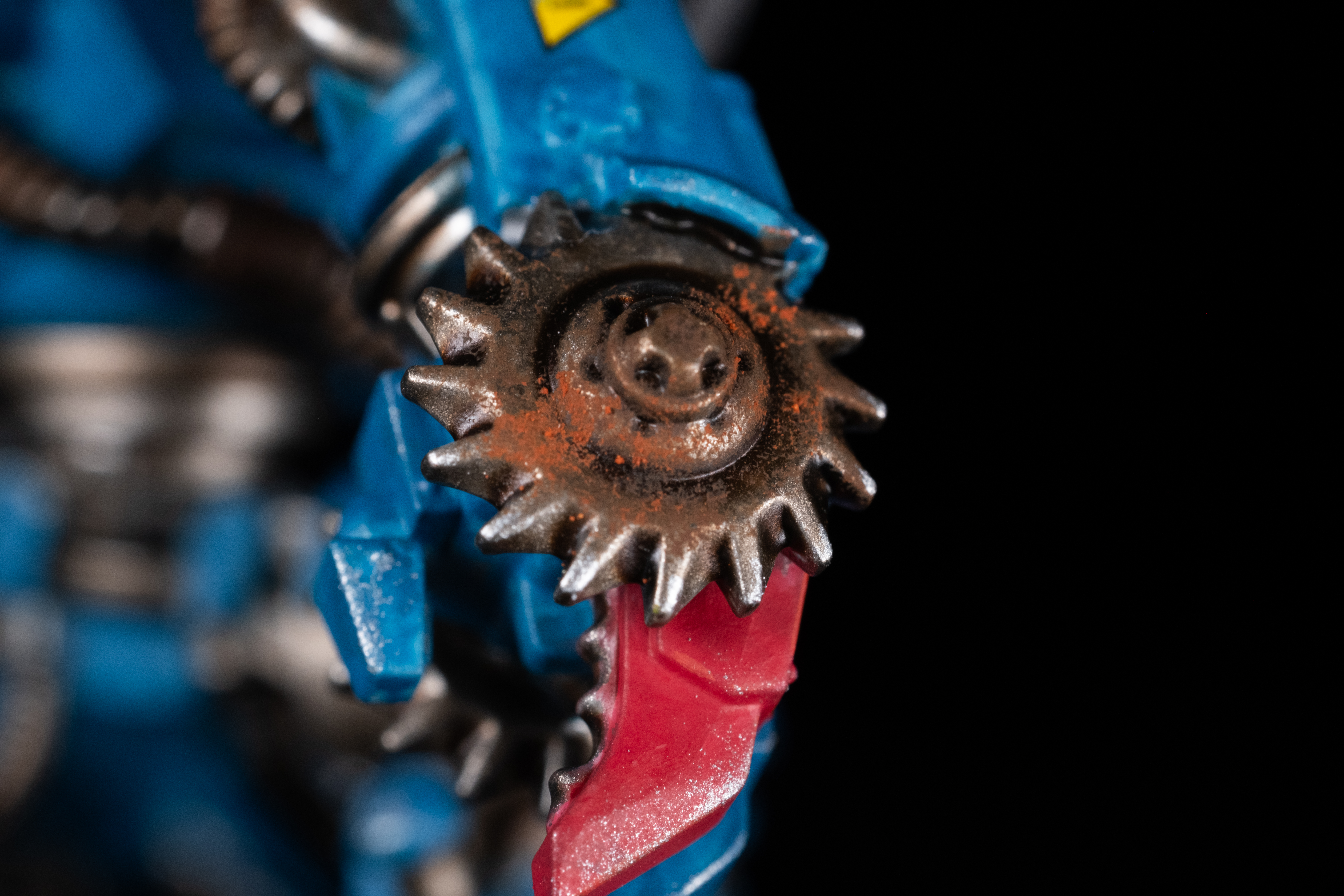
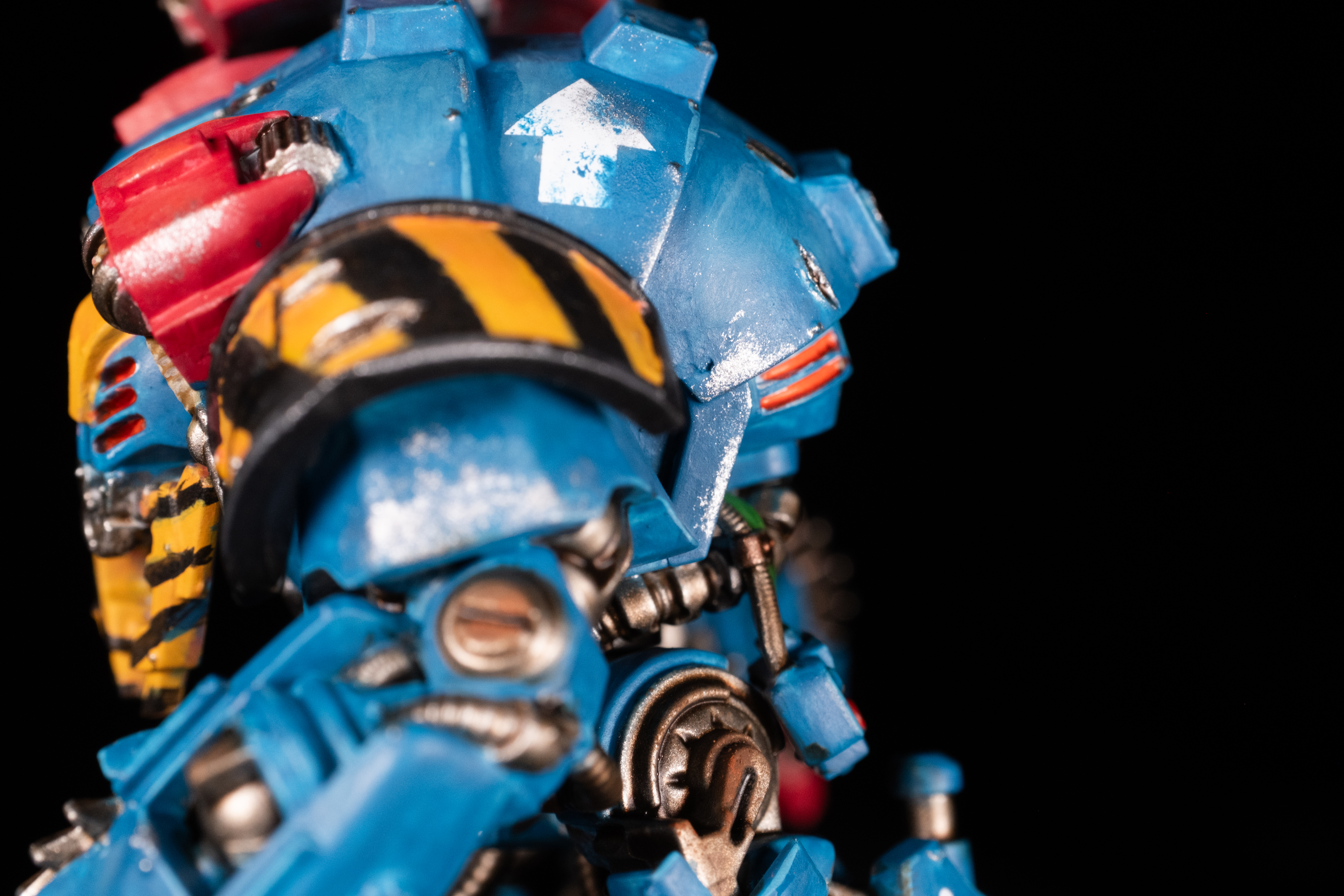
The decals were another aspect that needed to be used sparingly - too many and it looks like a European hockey league jersey. (Though probably fitting for a Cyberpunk dystopia for an ad to be shoved onto every piece of physical real world space, Necromunda doesn’t really have that neon cassette futurism vibe.) I opted for a couple in some prime locations (up means up, after all) and tried to hit them with some weathering to take the “glossy straight from the factory” shine off them. Particularly fond of the up arrow, the sawblade warning, and the inset shoulder marking.
The rust was fun to do - I used a slightly different process this time, and while only hitting a few key spots on the model itself, used it liberally on the base. Usually for Necromunda bases I include some hazard stripes (because there’s no good place to put hazards on a Delaque ganger) but since the model contained a not-insignificant amount of hazards I instead opted to just do a heavy oil stain and rust base, to give it a little brown-orange tint to make the blue Ambot pop more.
What did we learn?#
- I should have painted this in subassembly. It’s a somewhat closed pose with a number of fine details all over, and I feel subassemblies would have make some of that less stressful (and less “now I gotta repaint this thing because I got paint on it trying to reach this other thing”). I don’t traditionally do subassemblies but I might need to make that into more of a standard process in my workflow.
- Blending needs work. This was a little bit of a wake up call - I feel like I used to be good at that, back when I painted Warmahordes (over ten years ago) but haven’t realy used it much.
- I also need to not be afraid to push highlights and lowlights. I kept finding that some instances blended “too well” to the eye at any distance - which I suppose is a sign that the colors are supposed to blend well, but they didn’t always register as “highlights” using the 3 foot rule.
CitadelWarhammer Contrast Medium is great for blending, but the paint pot form factor is a pain for getting the mix just right. It was used on the hazard stripes and the base color blends to great effect. The annoying pots get remedied later on…- Weathering is tons of fun, but it’s really a case of “know when it use it” and “know when to walk away.” It’s one of those things that you can easily go overboard on. It’s also very much a per-case basis: it works on Necromunda models because Necromunda is a hellscape of a world, but probably doesn’t fit in, say, when painting Blood Bowl. I’m even hesitant to use it on 40k stuff at times.
- When you decide to participate in something, make sure you know when the event takes place.
Ultimately I’m happy with how it turned out. This model pushed me, and I walked away with experience in processes I wasn’t used to using. Certainly I can see parts where I know I could push an element further, but I suppose that’s natural when I’ve been holding the thing inches from my face for over a week.
Anyway, I started the Ambot on the 5th (after realizing my mistake) and finished it on the 14th. Since the event was on the 19th, that gave me 5 whole days (not really) before the event. Instead of leaving well enough alone and taking a model from my shelf like I had originally planned, instead I decided to scratch paint another bespoke model:
Skaven Ikit Claw kitbash#
This was part “paint something to get it off my table” and part “I have a dumb idea and I’m going to make it everyone’s problem.”
First, the idea: I don’t remember what I was reading or looking at, but something stuck in my mind-maw about Goblin Green bases (again). So I thought to myself, what better way to stand out at this painting event than something that looks like it came right out of the back of a 4th edition rulebook?
The only problem was, what model do I use for this dumb idea? (I’m definitely punching above my weight with this plan re: my painting skills.) Enter: my Ikit Claw kitbash.
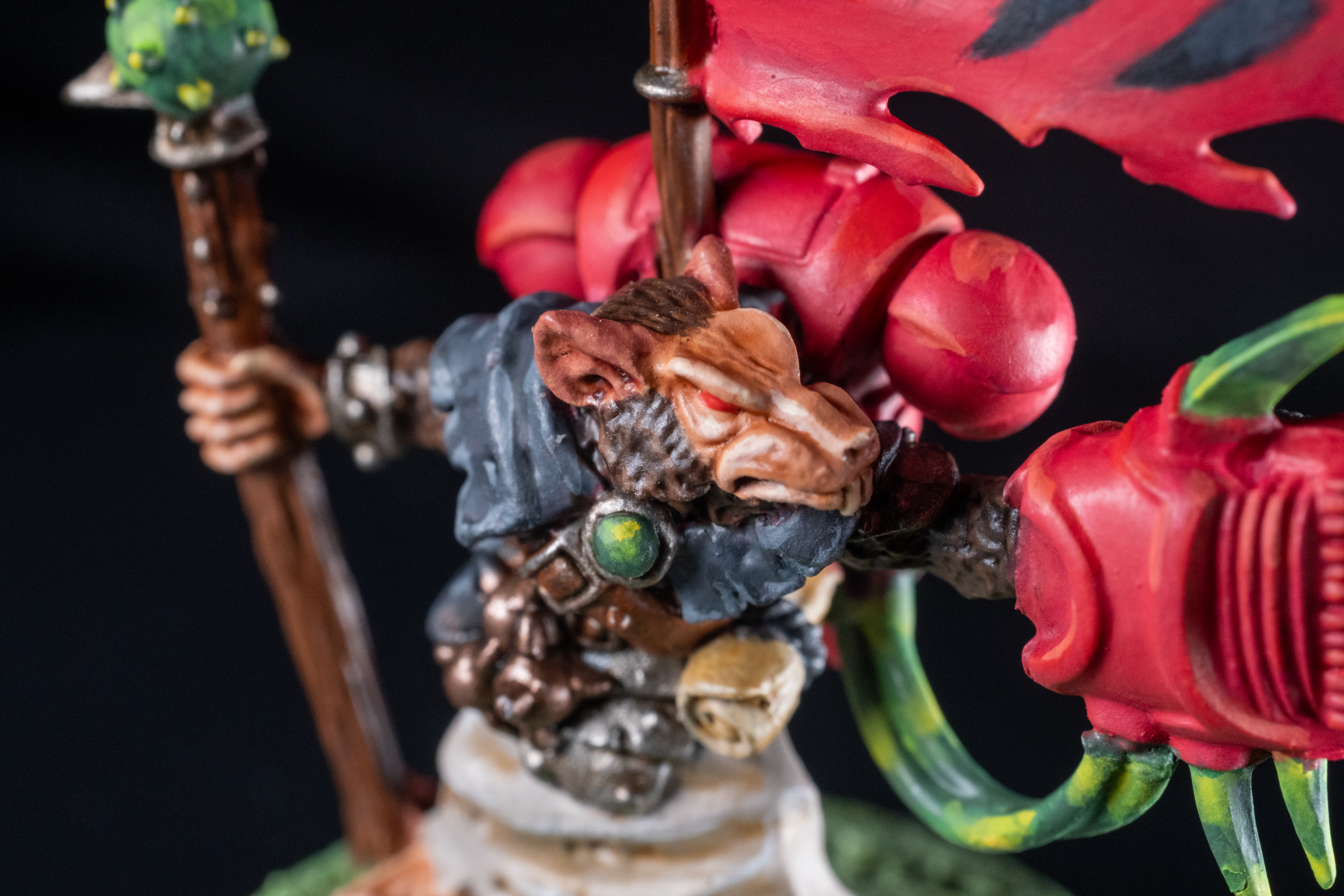
We’re going to take a quick little jaunt through my personal history with the Skaven and Warhammer in general.#
I was … 12? Actually probably 10 or 11 when I was first introduced to Warhammer (Fantasy Battles) by my cool older cousin. He had a Lizardman army and a handful of other faction books (for both WHFB and 40k). So I had access to the models (as much as he would let me mess with them), the rules (as filtered through a 16/17 year old), and the world (through the various books). He told me all about the different factions.
But when I was 12 I got a copy of the 4th edition Skaven rulebook. I didn’t have any models. My parents weren’t very keen on all the cool things my cousin introduced me to (Dungeons and Dragons, Warhammer, Magic, Diablo, etc) so little to no chance for playing the game. But I poured over that book, read it cover to cover and back again. Read all the lore, all the character information. So much cool content jam packed into that Skaven book. Bells! Doomwheels! Warpstone! Probably the only 6th grader who could tell you about the Doom of Kavzar.
Bottom line: never got to play WHFB. Flash forward to 2021(or 2022? time has no meaning post-2020) when I got into 40k. It wasn’t immediate, but I started to toy around with getting some Skaven, finally. (Years before, when I played Warmahordes and already had that toe in the hobbying … hobby, I had actually bought the Isle of Blood box set (because Skaven), assembled it, and painted a few. But now I had people who I could actually play with.) But in learning everything that transpired between WHFB End of Times and the introduction of Age of Sigmar, I was crestfallen to find that Ikit Claw, my absolute favorite character, didn’t exist anymore. I mean, he invented the Doomwheel! And he was just deleted from the canon.
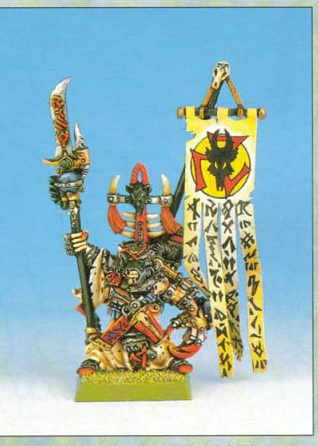
Ikit 2.0#
So I took it upon myself to build an Ikit Claw (because I sure as shit wasn’t going to pay eBay prices (okay looking now they’re not actually that expensive. Guess the Ikit Claw bubble, like all good Skaven inventions, burst)). So I took an old metal Warlord Claw Leader, slapped on a Space Marine pack, a Lightning Claw Power Fist … thing, and a spare Skaven Clanrat banner and, voilà, a true Skryre horror:
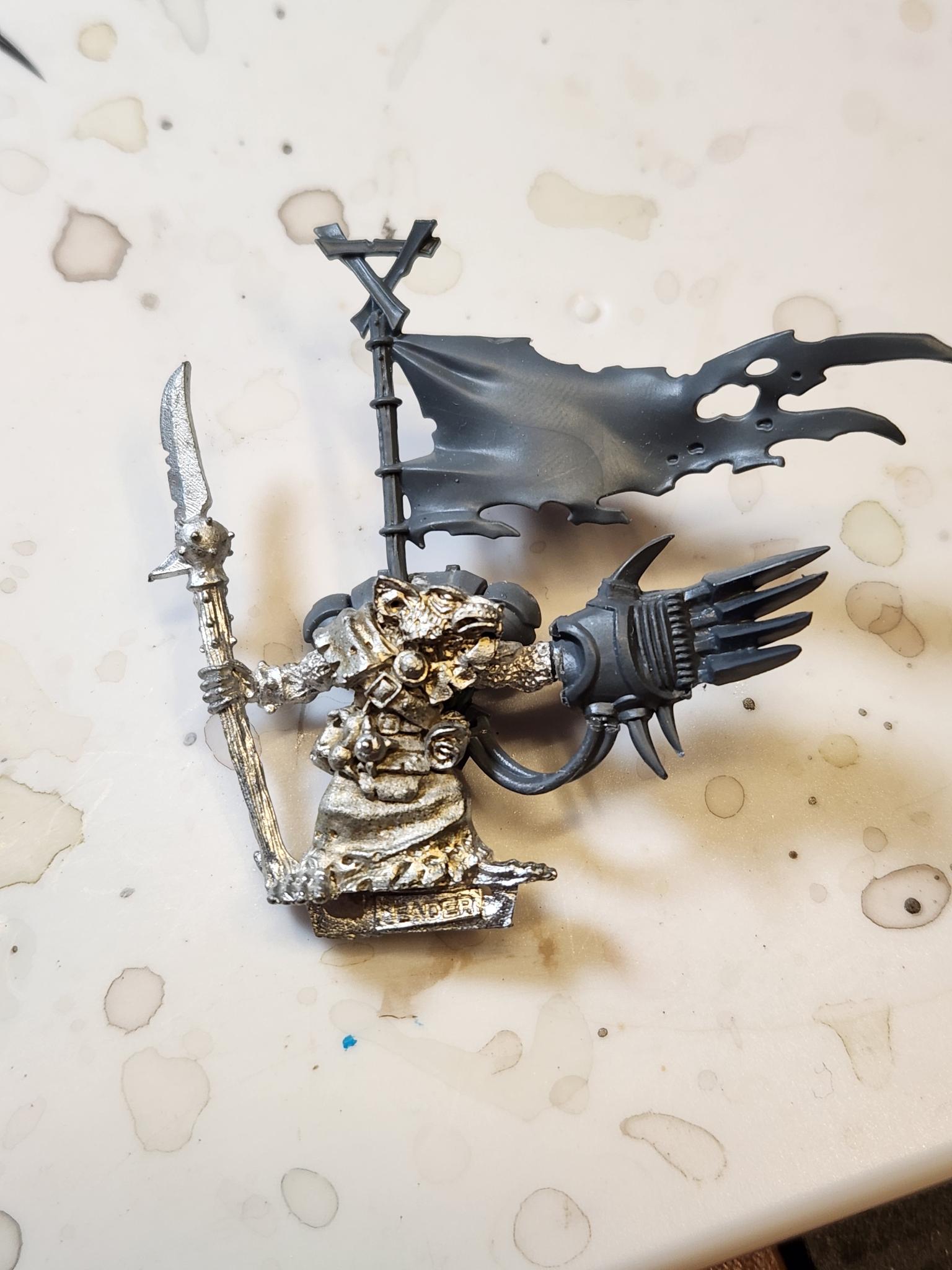
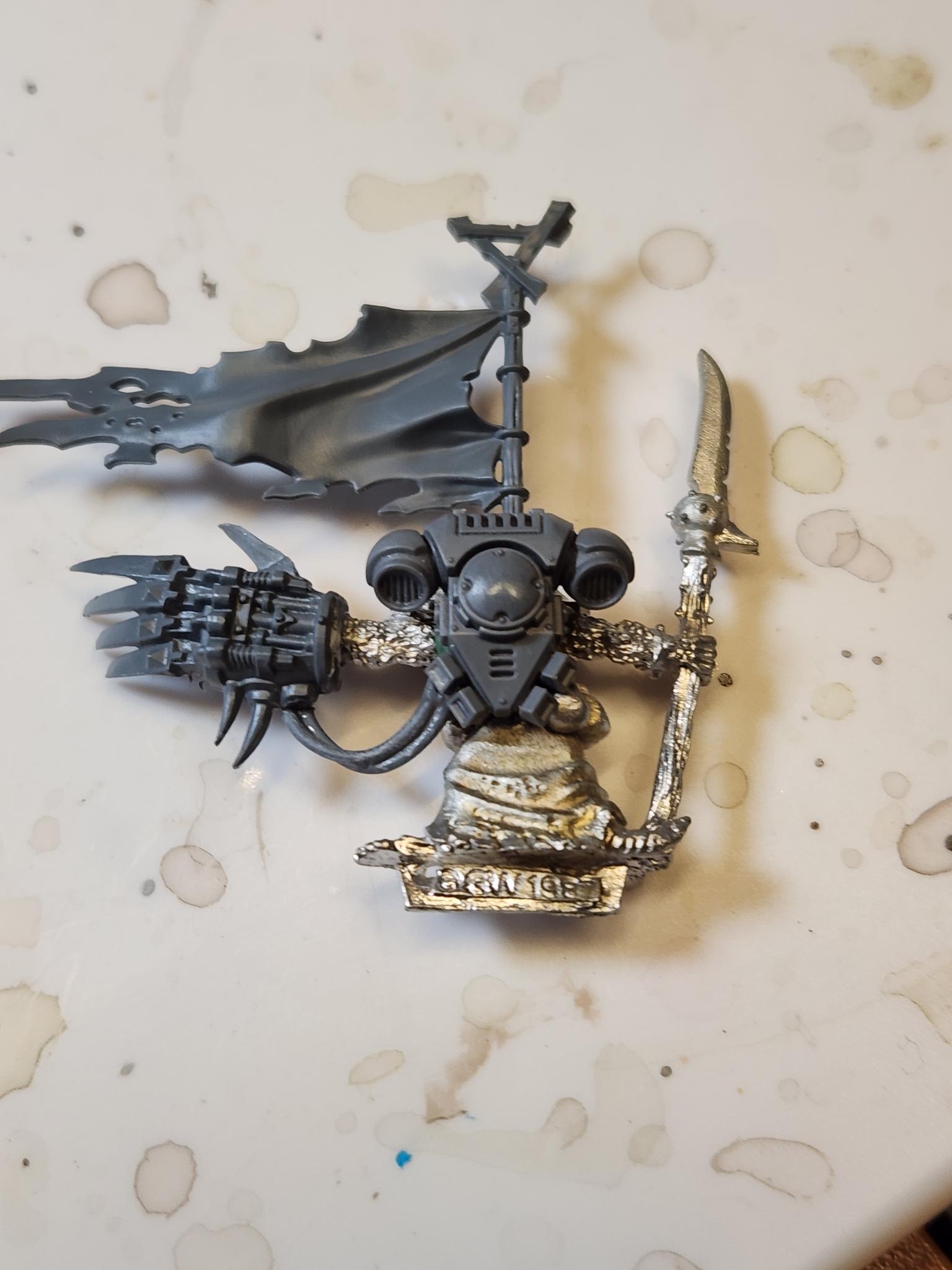
After building this, it sat on my painting desk for maybe a year (?), naked and unpainted as the day it was kitbashed. (In fact, the kitbash images above are from the 14th, while I was still toying with the idea on painting it.) It was always one of those “I’ll get to it later” projects.
It seemed perfect to try and paint in a slightly retro style.
Much like how I wanted to use the Ambot to push my weathering, with all the fabrics I wanted to push my blending on this one. I also wanted to try to stick to 90’s ‘Eavy Metal style best I could, between my personal skill level and general paint technology improvements (no bright yellow in place of gold for me). So with Goblin Green base in mind, I set off.
As a much smaller model than the Ambot, things overall went pretty smoothly. The hardest part was probably conforming to the “official” GW palletes for some things (such as the skin and robes) instead of falling back into my personal standard. In addition to the blending, I pushed skin highlights in a way I haven’t before, and gave everything at least 1, if not 2, levels of highlights instead of my classic “base coats and a wash” that Clanrats tend to get.
Inititally I had given the model even more red, trying to lean into a comment from a Warhammer Community article describing ‘Eavy Metal through the years that mentions
Red was the chief accent colour of choice […]
so by god this rat was going to have red. Initially the shawl/collar/thing was also red, but that created a visual issue where, from the front the shoulders just melded into the backpack. Highlights might have fixed that, but I didn’t want to chance it. Plus, changing it to black better mirrors the original Ikit Claw model with the black robes and hood.
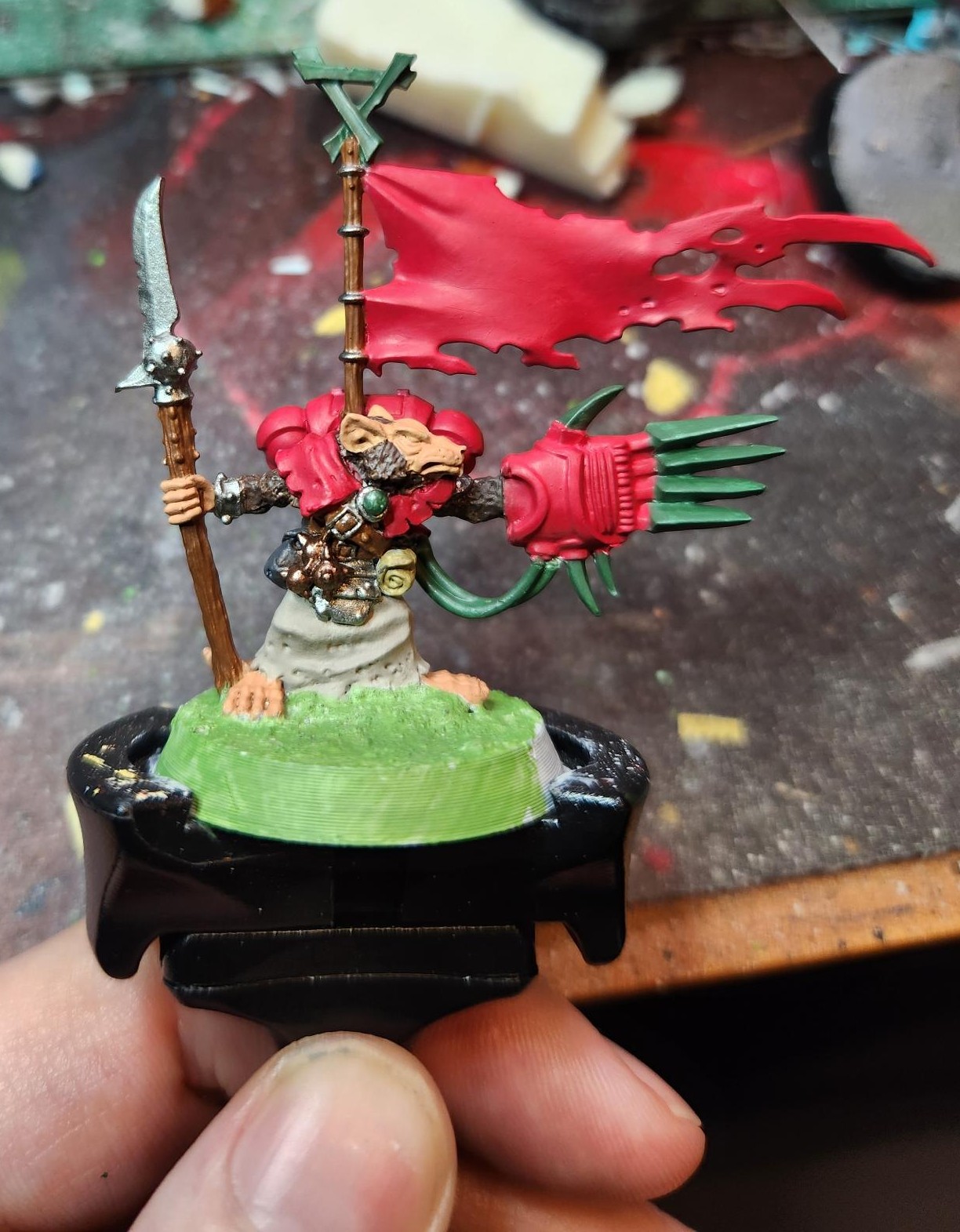
Blending reared its ugly head again, and at times I struggled with it. Definitely still something I need to improve on. But as I was finishing up the Warpstone pieces and moving on to the flag freehand, I felt like I had a slightly better handle on how to transition between colors without such as harsh line.
The secret weapon? Replacing Citadel Warhammer Contrast Medium with Army Painter Speed Paint Medium. The dropper bottle is a lifesaver - no more having to dip a brush for the paint, clean, dip a brush for the Contrast Medium, put it somewhere else on my pallete close to but not on the first paint, and god forbid you get the wrong ratio. the AP medium I can just drop a measured amount each time without having to alternate brushes or create a DMZ on my wet pallette between paints.
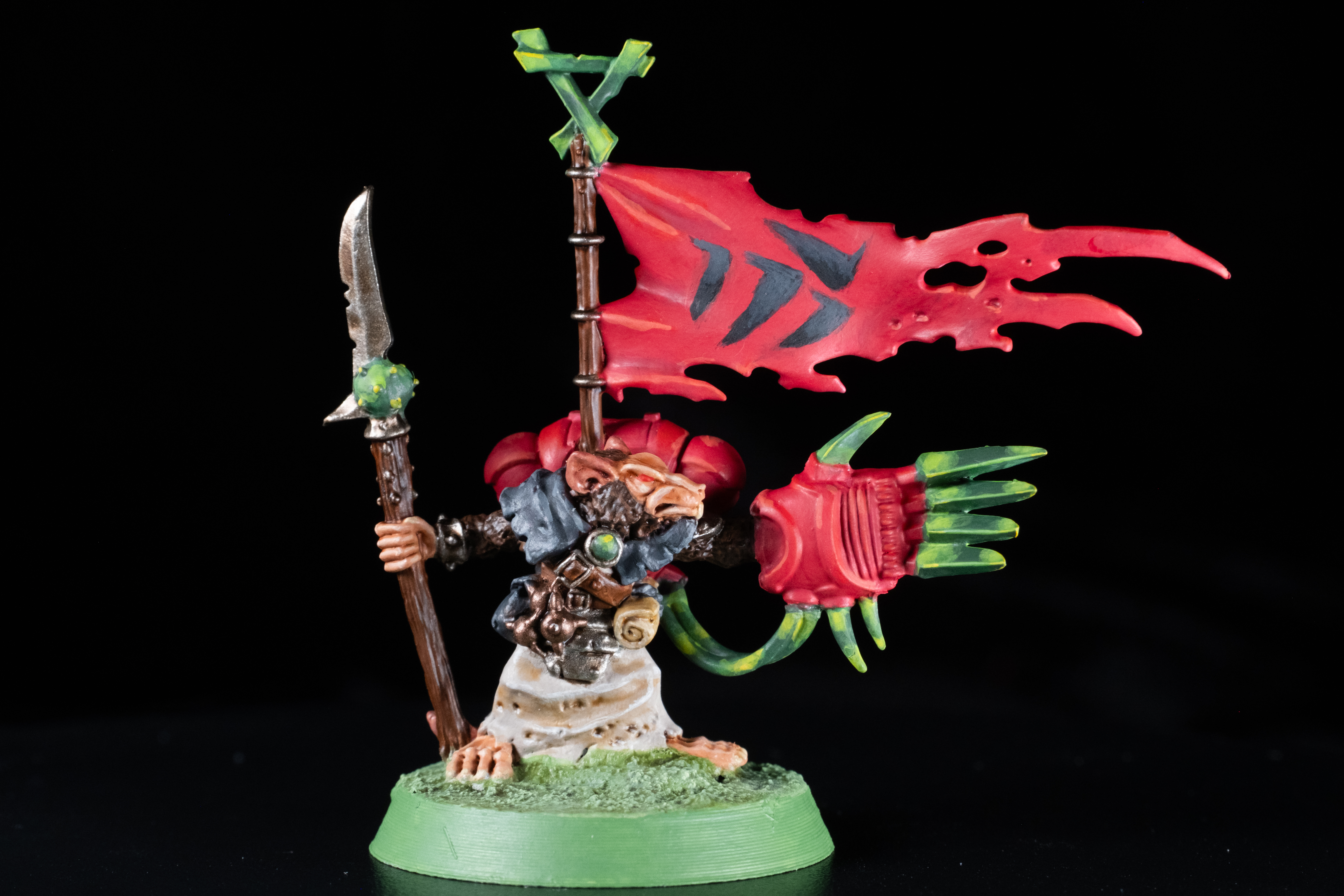
The flag was a bit of a sticking point. I saved it until the ultimate last step because I was dreading messing up the highlights and blending I accomplished with a shit freehand job. I wanted to do something a little “ambigiously Skaven” and not a specific clan marker or something, since my army in general is just “whatever Skaven I have.” I sketched a bunch of ideas trying to figure out what I could fit in the given space but it was still not something I was looking forward to.
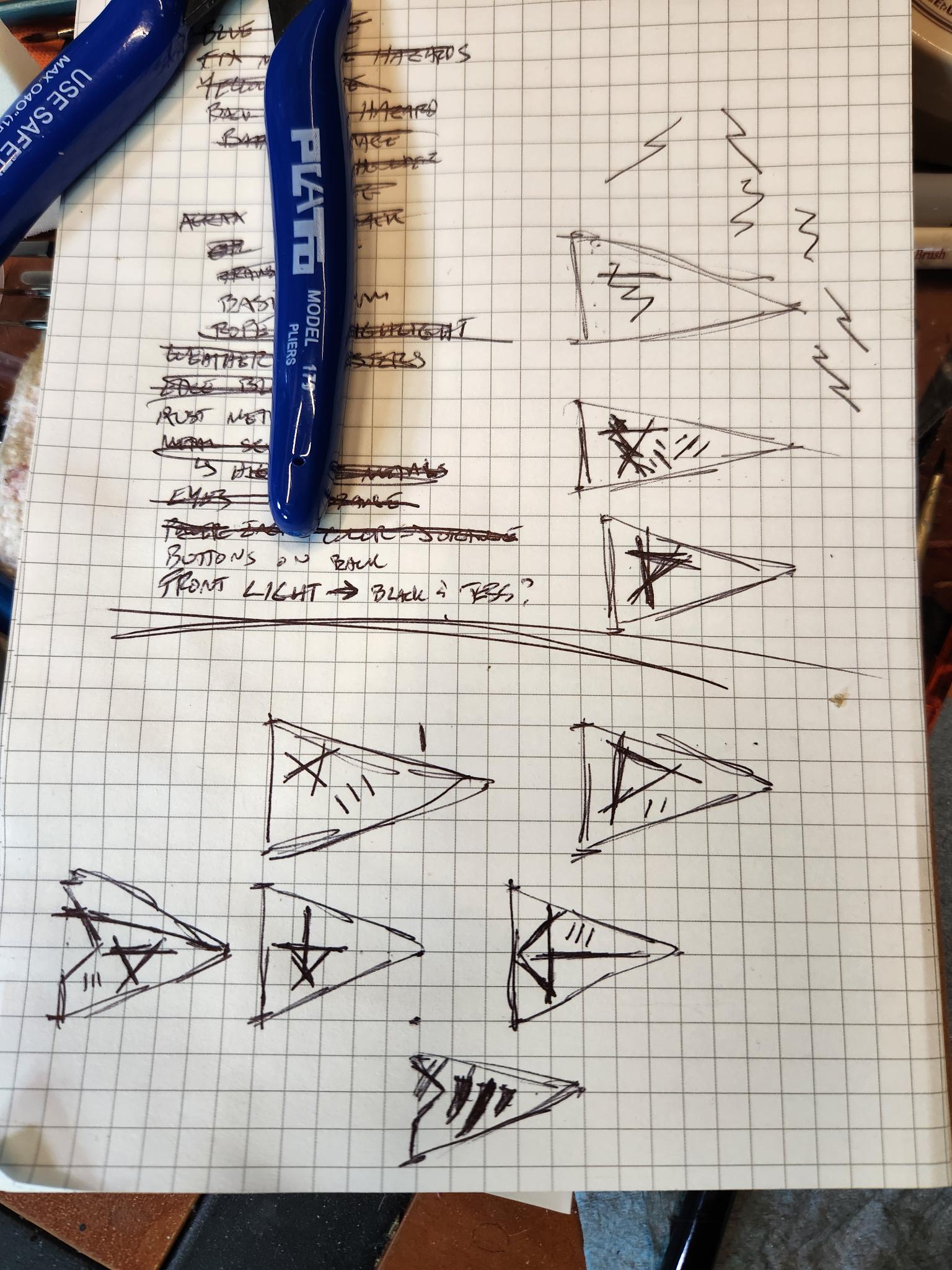
As I iterated on the design I continued to realize I didn’t have as much space on the flag as I thought to freehand and the space (and design) keep getting smaller and more simple. Yeah, yeah, more practice means I get more experience with it and it stops being scary. But still. I didn’t want to cut my teeth on a model that was going to be critiqued for an event. I mean, that’s what I did, but still.
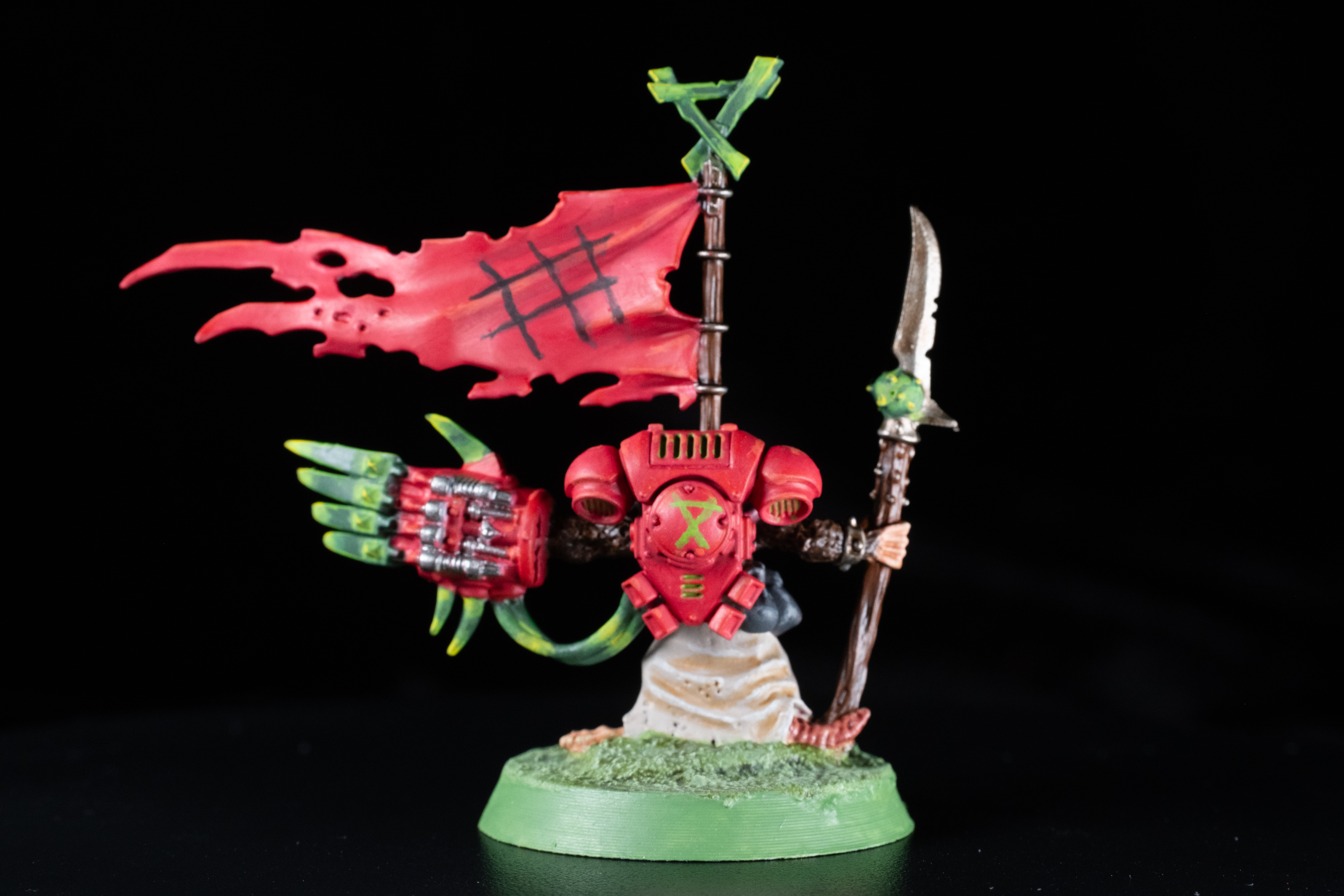
Expanding on the hazard stripes from the Ambot, I wanted to force myself to do more freehanding since there was this nice, big flag. And why not take freehanding one step further and add blending into that mix too? Since I wanted to avoid the standard Skaven triangle on the front because it was already on the flagpole, so I went with a set of claw marks, blending from highlights to lowlights. (The back of the flag is a far more simple design because I found the folds in the cloth to be more in the way.)
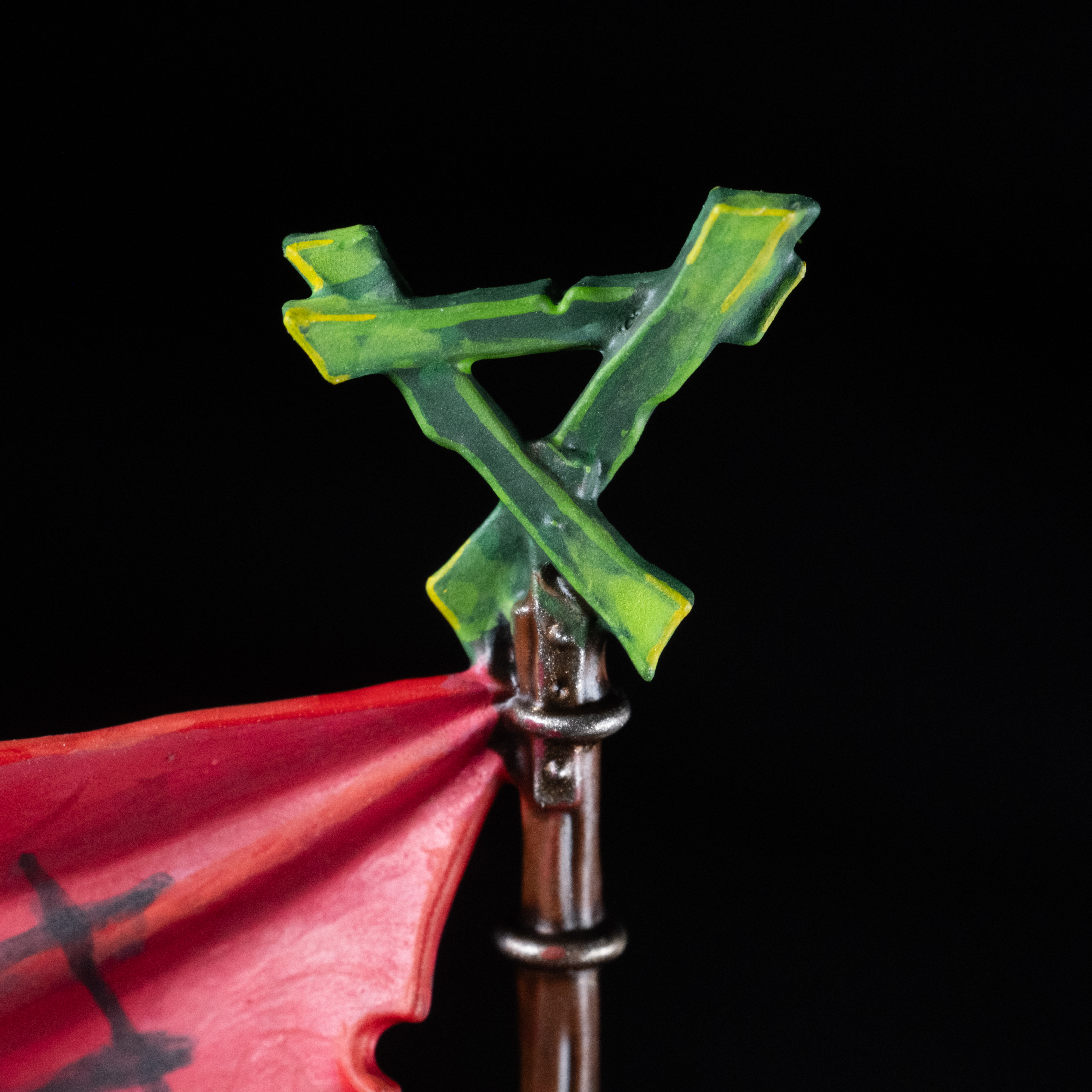
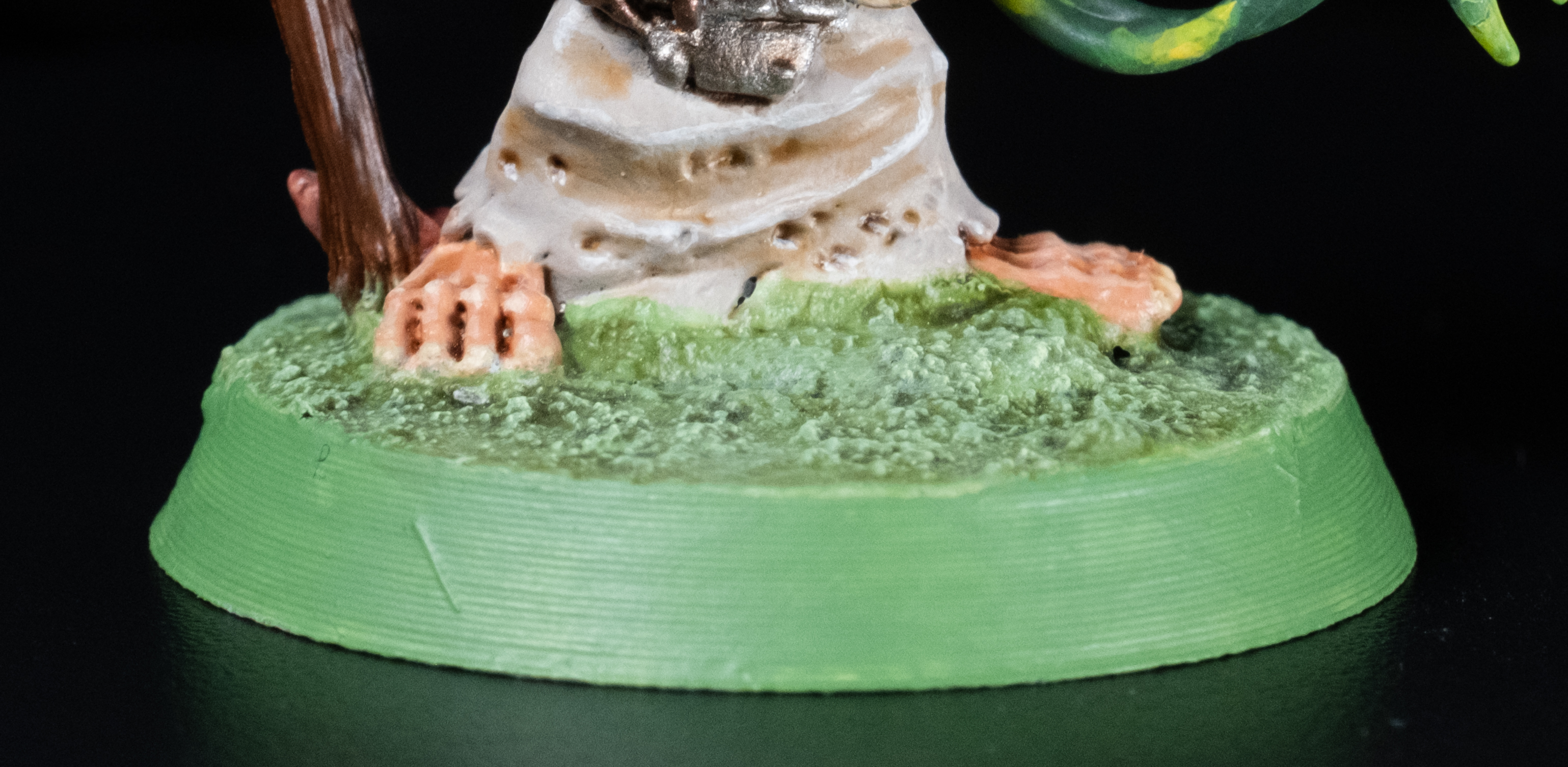
And of course, the Goblin Green base. Like any good rug, it ties the room together. I ended up going down a rabbit hole for this part, trying to figure out the best way to replicate the classic Goblin Green. Everyone on the internet says there’s no 1:1 replica of it currently (not even the Nostalgia ‘94 attempt). I have never seen so many ranking charts for the same 7 or 8 green paints in my life. Everyone claims to have the secret recipe to mimic it. I tried a few but just relied on Warboss Green, which gets the most mentions in modern painting guides that I can find and even gets a call out as the official “modern” way to paint Goblin Green bases by Games Workshop.
What did we learn (again)?#
- Not sure if this is a universal truth but I’ve found metal models respond better to spray primer than brush on primer. Spent basically half a day applying and reapplying primer on problem parts of the metal model.
- I 3d printed the base because I needed something with a slot (felt that was better for stability than trying to remove the slot and pin the base) but really I should have just swiped a spare Blood Bowl base instead. Similar to the primer thing above, 3d prints need a couple layers of varnish before the material stops soaking up the paints and you can just paint on them normally.
- Freehanding. My god, freehanding. Compared to the flag design, the Ambot was Babby’s First Freehanding. I agonized over the designs (above) in part to figure out a good design and in part to delay actually having to paint freehand. It’s something I should work on more, but like weathering and Necromunda, doesn’t translate to every model I paint (such as Tau).
- (Jan Brady voice) Blending, blending, blending! Another thing to continue to work on. I feel like the highlights on this model were more pronounced, now I just need to get from one to the other in a smoother manner.
- When you get a dumb idea, follow through with it and make it everyone’s problem.
All in all, very happy with how this model turned out. A combination of a fun kitbash, one of my favorite characters, a unique style (it’s definitely going to stick out amongst the rest of my Skaven army), and I feel a job well painted. One of those things where 12 year old me was reading the army book and dreaming of having and painting an Ikit Claw model and now I’ve finally done it. I don’t know if it’ll win but it’s a winner to me.
A new lap record#
A new thing I did with this Ikit Claw model was time myself. I’ve been asked before how long it takes me to paint any given miniature, and I never have any idea. I finally found an app that will track paint sessions for you by model (and isn’t subscription based) so I gave it a try. By the time I found this app, I was already like 90% done with the Ambot so no point in tracking that.

Over three days the model came in just a touch over six and a half hours with a 2 hour 10 minute per day average. One thing I did learn about myself using this is most of my painting is done in 5-10 minute sessions, with the longest being about half an hour long. I need to stand up and move around and let my eyes uncross every so often. I don’t plan on timing every model I paint going forward (though it would be interesting to have that metric for my monthly wrap ups) but probably spot check models here and there such as “how long it takes to paint a Tau Breacher” or what have you.
So how will these models do? Maybe I’ll update this post with the results. Here’s to hoping.
If you want to get ahold of me, you can now reach me at floppyparts@proton.me. Send me whatever you want.
